Marginalia

An Early Music Blog

Welcome to Marginalia

If you've stumbled here expecting some sort of sensible discourse on early music then I'm afraid you've taken a wrong turn.
What follows is, broadly speaking, stuff: articles, scores, book reviews, that sort of thing.
Why Marginalia, you ask?
The answer, my friends, is this: the margins and the crossroads have always been the juicy spots.
You see, the interesting stories have never belonged to the prim and proper middle of the page where Latin letters sit in neat rows. The true vitality, the essence of medieval creativity, lives at the edges. There, knights are duking it out with snails. Bishops ride goats with solemn conviction. Rabbits roll up armed to the bloody teeth.
The centre of the road is for getting places efficiently. And who, in the name of Pythagoras's trousers, wants that? Not us, my friend. Not us.
If you're seeking clean, polite answers and respectable musicology, let me save you the trouble.
You didn't land in the main text.
You landed in Marginalia.


Pipeworks

An Organological Situation

FLUTES OF THE MIDDLE AGES

The transverse flute showed up from India via Byzantium and promptly got nicknamed the 'German flute'. The gemshorn had its entire moment, peaked around 1488. The recorder's ancestors were lurking around courts and banquets. And the more you dig, the stranger it gets...

The Sound of one hand piping

This ingenious contraption exploded across Europe in the mid-thirteenth century. One moment it barely existed; the next, manuscripts from England to Spain were depicting the same curious instrument combination.
Every region claimed it with a different name: the galoubet in sun-drenched Provence, the Schwegel in German-speaking lands, the txistu in the Basque hills. But the appeal was universal. Need music for a Burgundian tournament? Pipe and tabor. Street festival in a Spanish town square? Pipe and tabor. Shakespeare's Globe Theatre needed atmospheric sound effects? You guessed it.

Drumroll, Please… No One’s Listening

Medieval Europe was absolutely littered with drums. Manuscripts stuffed with tabors, nakers, bells, the whole percussive circus.
Angels banging frame drums, devils keeping rhythm, minstrels everywhere making a glorious racket. Then you open the actual scholarship and... they've all buggered off to the pub.

A Pipe out of place

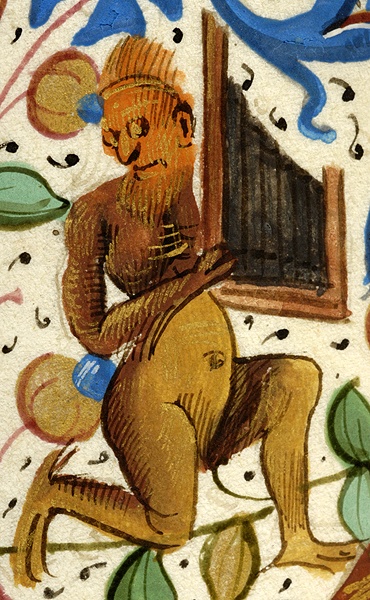
The frestel, medieval Europe’s answer to the panpipe, held the iconographic high ground for a good three centuries before vanishing around 1300.
Fashioned from boxwood, with neatly convex ends and a monoxyle construction, this single-handed marvel found itself equally at home on cathedral portals and skulking in the margins of manuscripts.
The frestel quietly lost its place. What remains is a single archaeological specimen and a handful of stone and painted representations, collectively staring back at us.

Viola d'Amore

Some insomniac Baroque courtier grafted sympathetic strings onto a viol, carved a leering Cupid on the scroll, and called it the viola of love.
What followed? This baby went rogue.
It spawned a whole dynasty of sound, and a dozen offspring from Istanbul to Oslo. It survived its own extinction and utterly confounded (almost) every scholar who tried to pin down where it came from.

Loose Cannon

Pedagogy of the Oppressed and Genesis of a Music

Liberation Through Demystification


A User's Guide to Medieval Shapeshifting

These musical monstrosities lurked in the great cosmic antechamber: the waiting room between a pagan past and the Christian future still shifting its sacks and sorting its saints.
They embodied everything medieval society claimed to fear: wildness, mutability, things with too many limbs... and everything it secretly adored.
Because deep down, everyone enjoys a dragon with a trumpet.

Animation as Illuminated Manuscript

While Pixar's spending millions rendering individual hairs, this studio is citing twelfth-century monks. From shape-shifting as resistance to folklore as survival guide, they've turned animation into illuminated insurrection.

Scribal Errors

Sheet Music & Transcriptions

Pype & Thumpe

Renaissance Pieces for Pipe and Tabor

Trio sonataTWV 42:D15

For Viola d'amore, flute, and continuo

The Division Flute

Born in the awkward aftermath of Puritan joylessness and continental envy, The Division Flute documents England’s rediscovery of fun via increasingly elaborate flute noises.